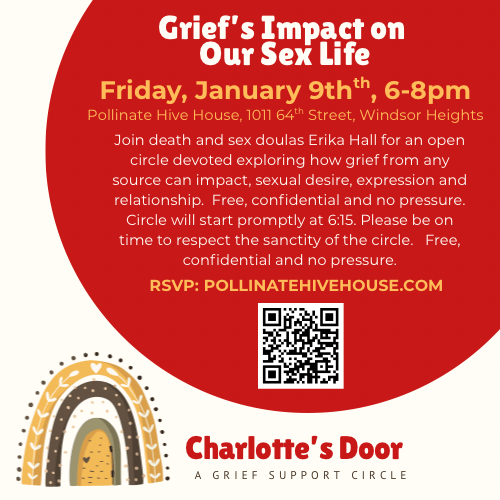
Talking about sex, touch, and intimacy after loss
Grief and sex. Two things we’re trained to talk about in whispers, if we’re allowed to talk about them at all.
But here’s the inconvenient truth: they’re tangled together. Not because grief is “romantic,” and not because sex is some kind of cure. They’re linked because both live in the body. Both are shaped by the nervous system. Both are ways we reach for connection, safety, relief, or meaning when life gets shaken.
And grief doesn’t only come from death.
Grief can show up after a divorce, even a divorce you wanted, even one that was necessary. It can show up when you lose a job, a home, a friendship, a sense of belonging, or the future you thought you were building. It can come from miscarriage, infertility, diagnosis, estrangement, betrayal, or simply the slow, brutal truth that something has changed and it won’t go back.
When grief arrives, it doesn’t politely stay in the “sad feelings” corner.
For some people, libido spikes. Touch starts to feel like oxygen. The body reaches for warmth, closeness, sensation, anything that says “I’m still here, I’m still alive, I’m still held.” For others, desire disappears completely. Touch can feel irritating, exhausting, or even unsafe. And for many, it’s neither. It’s messy. It fluctuates. It makes no sense from the outside.
None of that means you’re broken.
That’s why our upcoming Charlotte’s Door Death Circle is making room for this conversation: grief and our sex lives.
Let’s name the thing people are scared to say out loud
A lot of people carry this unspoken rule: Sex and grief can’t coexist.
So if desire shows up, guilt often shows up right behind it. And if desire disappears, shame starts whispering that you’re “cold,” “broken,” “too much,” “not enough,” or somehow failing.
Nope. That whole script needs to go.
Grief doesn’t care about etiquette. It changes your body. It changes your capacity. It changes how you connect. It can make you want closeness desperately, or it can make you want everyone six feet away, thanks. Sometimes it does both in the same week, even in the same afternoon.
Different kinds of grief can hit in different ways
Let’s talk about the grief people don’t always “count,” even though your nervous system absolutely counts it:
- Divorce or breakup, even when it’s the right choice
- Miscarriage, infertility, or complicated pregnancy experiences
- Job loss, financial instability, retirement, or career identity shifts
- Friendship loss, betrayal, estrangement, or being cut out of a family system
- Diagnosis, disability, chronic illness, or caregiver burnout
- Moving, losing community, losing safety, losing a sense of home
- And yes, of course, death
Grief isn’t a competition. Your body doesn’t care if someone else thinks your loss is “big enough.”
Three common grief-and-libido patterns (and all of them can be normal)
1) Libido drops
You might feel numb. Tired. Unreachable. Like your body’s turned the lights off to save power. You can love someone deeply and still not want sex. That isn’t rejection. It’s capacity.
2) Libido spikes
Sometimes your body reaches for touch because touch is grounding. Because sensation is proof of life. Because closeness helps you feel less alone. That doesn’t mean you didn’t love what you lost. It means you’re human.
3) Libido gets unpredictable
You want closeness, but not sex. Or you want sex, but only if it’s slow and safe and you can stop. Or you start out feeling into it and then grief barges in mid-kiss. This one confuses people the most, because it can look like mixed signals. Most of the time, it’s just mixed needs.
If you’re partnered, this is where things get tender
Grief can make two good people land in opposite places.
One person wants touch to cope. The other can’t stand being touched. One person wants sex because it feels like connection. The other hears sex as pressure. One person wants to talk. The other can barely form a sentence without crying.
That mismatch doesn’t mean your relationship is doomed. It means you need a language that isn’t guesswork.
Stop making sex the only doorway to closeness
If sex is the only way you know how to feel connected, grief can turn your relationship into a high-stakes negotiation. Nobody needs that while they’re already carrying a loss.
Instead, widen the definition of intimacy. Give yourselves more doors into the room.
Here’s a simple tool that keeps people from guessing wrong:
Green / Yellow / Red (for touch and intimacy)
- Green: “This feels good right now.”
- Yellow: “Maybe, but slow, and I need check-ins.”
- Red: “Not today.”
You can use it for:
- cuddling
- kissing
- massage
- hand-holding
- sexual touch
- sex
- sleeping close
- talking about the loss
- being around other people
No drama. No court case. Just information.
A permission slip for the parts of grief you don’t know how to say
If you grew up in a grief-avoidant, sex-avoidant culture (hi, most of us did), you may need actual permission to speak.
So here it is: you’re allowed.
Write this down somewhere private:
“I give myself permission to notice what grief has done to my desire, without judging it.”
Then add: “I don’t have to act on any feeling to prove anything.”
Then finish with: “Right now, I need ______.”
That last blank matters more than people realize. Grief makes couples fight about sex when what they’re really fighting about is safety, reassurance, loneliness, or fear of being left behind.
If you’re single or dating while grieving
Dating while grieving can feel like walking into a room where everyone else got the rulebook and you didn’t.
You might crave touch but not commitment. Or want companionship but have zero bandwidth. Or feel guilty for wanting anything at all.
Here’s a boundary that’ll keep you from betraying yourself:
You don’t owe anyone access to your body in exchange for kindness.
You also don’t have to apologize for wanting closeness.
Go slow. Tell the truth in the size you can manage. Keep your yes honest and your no clean.
When extra support is the right move
If your grief is flattening your day-to-day functioning, if touch triggers panic or shutdown, if shame is steering your choices, or if you and your partner are stuck in the same fight on repeat, it’s a good time to bring in more support.
That’s not a failure. That’s good triage.
Why this belongs in a Death Circle conversation
Because grief affects bodies. Because bodies carry grief. Because sex is one of the first places shame tries to move in after loss.
And because there should be spaces where you can say:
- “I miss them and I miss being touched.”
- “My libido came back and I feel guilty.”
- “My libido disappeared and I feel broken.”
- “I want closeness, but I don’t know what kind.”
In our Death Circle, we’re not here to fix you. We’re here to name what’s real, loosen shame’s grip, and make room for honest, consent-centered humanity.
Further reading
Sexual Medicine Society of North America: The Impact of Grief on Libido and Emotional Intimacy
Counseling Today (American Counseling Association): Why, when and how to talk with grieving clients about sex
Grief and Sexual Intimacy: Exploring Therapists’ Views of Bereaved Clients (International Journal of Sexual Health, full text via PubMed Central PDF)
 Rosemary Raven Hearth
Leave a comment