It Was Never “Just” a Pet
I still feel every pet I’ve ever lost in my heart, and I still grieve each one.
Thunder was the first. She was all black with a white spot on her belly, and I loved her fiercely. She was the first pet that chose me as her own, and she died when I was nine. I’m decades past that now, and I still have moments when I miss her so terribly I feel like my heart will shatter. That’s not a wound that didn’t heal. That’s love that didn’t stop.
Since then, there have been others. Sierra. Zelda. Lola. Branwyn. Shai. Frank. Moe Moe. Spaz. Howard Henry. Each one sits within my heart, and each one gave me a gift I carry forward, hopefully as a better person. I carry their dog tags on my keys, the ones I lost as an adult. Not as a memorial, exactly. More like a reminder that they walked beside me, and that I’m different because they did. I have tattoos that honor them. And I think of them with the same love and grief I hold for my mother, grandparents, and great-aunt. Family is family, no matter the shape.
I tell you all of this because if you’ve lost a pet, you already know what people are going to say. You’ve probably already heard it.
“It was just a cat.” “You can always get another one.” “At least they had a good life.”
And maybe you nodded, because what else do you do when someone hands you a line like that while you’re falling apart? You smile. You say thank you. You go home to a house that’s too quiet, and you grieve alone, because somewhere along the way you absorbed the message that this kind of loss doesn’t count.
I want to be really clear about something: it counts.
The grief no one makes room for
When we lose a pet, we lose a relationship that operated on a frequency most human relationships never reach. There were no arguments about politics at the dinner table. No passive-aggressive texts. No misunderstandings rooted in ego. What you had was presence. Routine. A body that knew your body. A being who was genuinely happy to see you walk through the door, every single time.
That’s not a small thing. That’s an attachment bond, and when it breaks, your nervous system doesn’t care whether it was a person or an animal on the other end of it. The loss registers in your body the same way. The empty space on the bed is real. The silence where the collar used to jingle is real. The instinct to check on them, to listen for them, to save a bite of whatever you’re eating… that doesn’t just stop because they’re gone.
Grief researchers call this “disenfranchised grief,” which is a clinical way of saying: you’re grieving something the world around you hasn’t given you permission to grieve. And when grief doesn’t get permission, it doesn’t go away. It just goes underground. It comes out sideways, as irritability, numbness, guilt, or that heavy exhaustion that doesn’t respond to sleep.
Why this grief hits different
There are layers to pet loss that make it uniquely disorienting, even for people who’ve weathered other kinds of grief before.
Your pet may have been the most consistent relationship in your life. Marriages shift. Friendships drift. Kids grow up. But your dog was there through the breakup, the move, the job loss, the pandemic. They were the constant. Losing them can feel like losing the thread that held a whole chapter of your life together.
I know that feeling in my bones. Branwyn and Lola were two cats who moved through three states with me, went through a marriage and divorce with me, a couple of complete career shifts, and so much more. They were my touchstones throughout. The beings I knew were never going to stop loving me.
There’s also the absence of ritual. When a person dies, there’s a structure: a service, flowers, people bringing food, time off work. When a pet dies, you might get a sympathetic look from your boss and a half day. There’s no cultural container for this grief, so you’re left to build one yourself, if you even know that’s what you need.
And if you were their primary caregiver, you probably had to make a decision about their death. That weight is enormous. Even when you know it was the compassionate choice, “I chose this” and “I’m devastated by this” are incredibly hard to hold at the same time. Both are true, and the tension between them can feel unbearable.
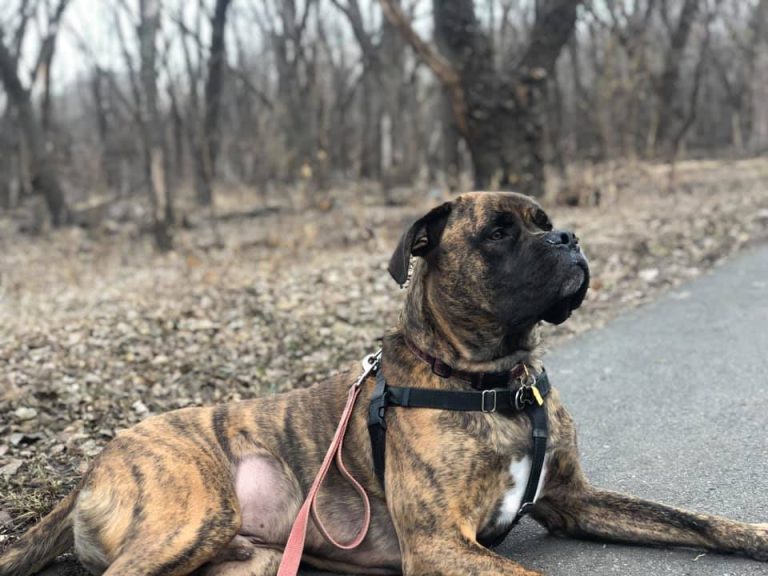
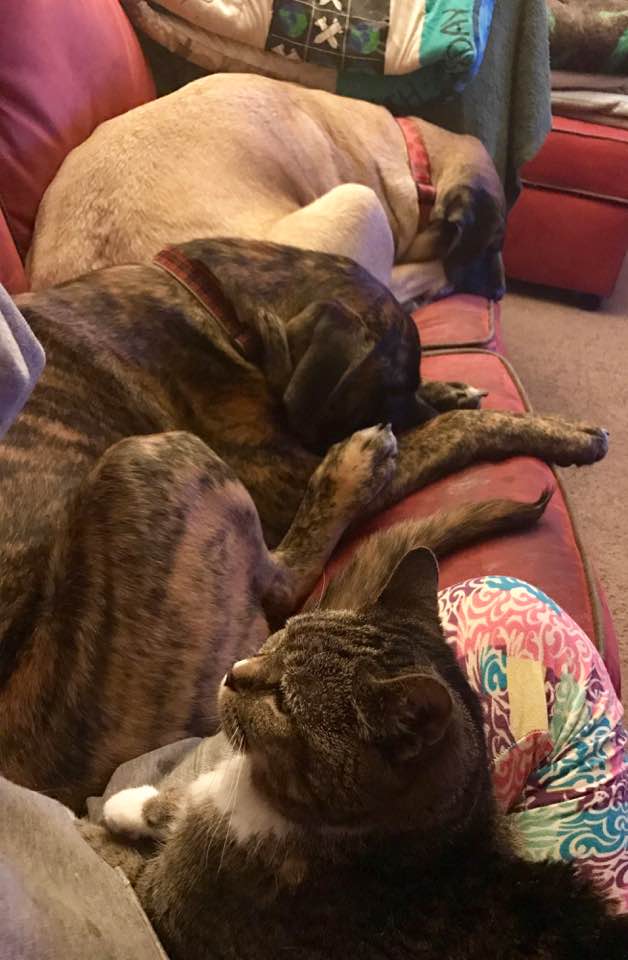
Howard Henry taught me that. He was a beautiful brindle Mastiff with the biggest heart I ever knew, and he died right before he turned four. He brought joy to everyone who met him, happy and kind as could be. He woke me up one Saturday morning in April having a seizure. I took him to the emergency vet, where they kept him overnight while the seizures continued. Norman, his cat, and I comforted each other through a sleepless night of worry at home. My vet got him out of the emergency hospital and kept him for a couple of days, but the seizures got worse, and then he stopped eating. It had been one week. I knew he was done. I knew he was letting me say goodbye.
He died in my arms the following Saturday, on my living room floor. I broke.
My whole heart shattered. I remember a friend lifting me off of his body, my whole body convulsing with a pain so deep I didn’t even know how to express it. Even as I write this, I can feel my heart clenching with the memory of it. The loss of a being I loved so deeply.
What I want you to know
You don’t need to justify the size of your grief. You don’t need to compare it to other losses to see if it “measures up.” You don’t owe anyone a ranking system for pain.
If your pet was your companion through hard seasons, your co-regulator when anxiety spiked, your reason to get out of bed on the days that felt impossible, then what you lost was a pillar of your daily life. Grieving that fully isn’t dramatic. It’s honest.
Here’s what I’d gently offer:
Let the house be quiet, and let yourself notice it. Whether you need a new companion right away or can’t imagine it for a long time, trust that. There’s no timeline for this, and there’s no wrong way to love the next one while still missing the one you lost.
Talk about them. Say their name. Tell the story about the time they ate an entire loaf of bread off the counter or refused to walk past that one house on the corner. Grief needs language, and your pet deserves to be remembered out loud.
If you made an end-of-life decision, let yourself sit with the fullness of that. You carried a tremendous responsibility, and carrying it with love doesn’t make it lighter. You can be at peace with the choice and still be wrecked by the outcome. That’s not contradiction. That’s tenderness.
And if someone tells you it was “just” a pet, you don’t have to argue with them. But you also don’t have to believe them.
You’re allowed to grieve this
I’ve sat with my own pet loss enough times to know that it doesn’t get smaller with practice. What changes is your willingness to let it be big. To stop apologizing for it. To let the grief be what it is, a piece in the puzzle of your love for each other, and to let that love keep shaping who you become.
I hold space for grief in all its shapes, including the kind that comes with fur and four legs (or feathers, or scales, or fins). If you’re in the thick of pet loss and you need somewhere to bring it, that’s exactly the kind of work I do.
You don’t have to grieve this alone, and you don’t have to grieve it quietly.
Erika is a grief companion and end-of-life doula supporting people through the losses that often go unwitnessed. Learn more about grief and caregiving support.
Stay close to the hearth
Writing about death, grief, sex, and the body. Delivered to your inbox.