I’m Not a Guide, I’m a Bridge
My very first death doula client came to me through a neighbor of mine. The neighbor thought this woman could use a death doula, and made the introduction. I’ll call her Sassypants here, the name I teasingly used for her, which tells you most of what you need to know about her.
In our first meeting she was guarded, and quick to tell me she “didn’t need any help making decisions on how to be old.” We talked for almost two hours anyway, and by the end we had a loose schedule for my visits.
My second visit, she put me to work folding clothes. We laughed and chatted. My third visit, we cooked together and she told me about her childhood and her marriage.
My fourth visit, she had a question for me, and it caught me off guard.
“What’s your goal for me?”
“My goal for you? What do you mean?”
“You’re here to make me feel good about being old and dying, aren’t you? But you haven’t told me to write letters to my loved ones, or given me your rules on how to make the most of the end of my life.”
None of those things had ever occurred to me. For a moment I worried that I was all wrong for a Death Doula. I wasn’t interested in giving homework or telling people how to be themselves.
She was expecting a playbook. I answered her honestly.
“How can I tell you how to make the most of the end of your life? It’s yours.”
It was an echo of what I’d told my grandparents when they stopped going to the doctor because they didn’t want to anymore. What I’d told my mother when she said she wasn’t going to do anymore chemo or radiation. I’d been saying the same thing for years without ever naming it. Sassypants was the one who asked the question that made me see it.
I wasn’t there to be a guide. I was there to be a bridge.
A bridge doesn’t decide the destination. A bridge can lead to a fork in the road. It can be walked over, walked under, or danced on. A bridge simply provides safe crossing.
A guide says this way. A bridge says where would you like to go? A guide has already decided where you need to end up. A bridge knows that wherever you arrive it is all yours.
The difference matters more than it might sound, because of where I work. Death, grief, and sexual embodiment are three of the places people have most often been guided toward outcomes that weren’t theirs to want. Religious traditions that tell people how to feel at funerals. Wellness frameworks that promise a five-step process to closure. Coaches who hand out scripts for pleasure as if pleasure had a curriculum. And so many contradictory self-help messages. By the time someone reaches me, they’ve usually been guided by at least a few people who were certain they knew the best way to live. And they’re tired of it. Or they’re completely confused. Or, more often, they think they must be doing something wrong.
So when I work with clients, in groups or individually, I’m not there to tell them how to know themselves. I’m there to provide the stability for them to take their own path. I’ll listen. I may offer observations or alternative viewpoints. I won’t offer a manual, and I certainly don’t set the rules.
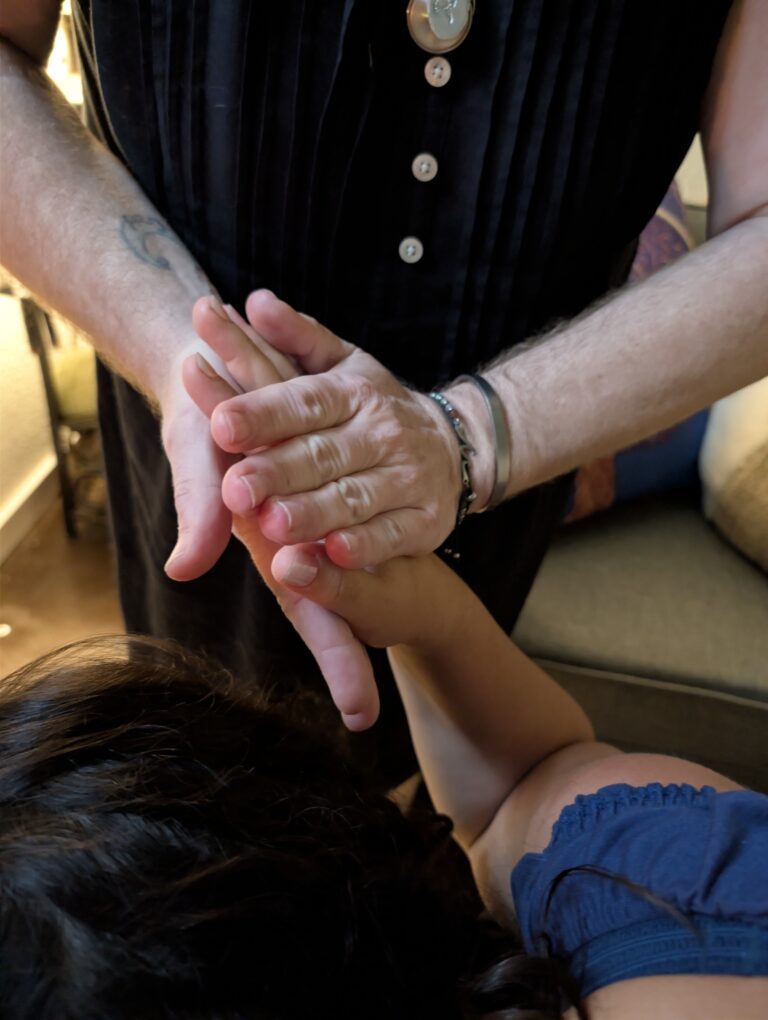
I was certified in Reiki and Tantra separately, more than a decade ago, and I’ve been using both in my life and my work ever since. Recently I decided to offer Tantric Reiki on its own as a formal part of my practice.
One of the first things I tell a new Reiki client is that I’m not a guide, I’m a bridge.
Tantric Reiki isn’t doing something fundamentally different from what I do with death clients, grief clients or sexual embodiment clients. The mechanism is the same. I’m there to acknowledge where energy is stuck, where the body or mind is struggling or trapped. I’m not there to tell anyone what their specific path is for moving through that. I’ll answer questions. I’ll share what I see or feel. The decision for what comes next always belongs to the client.
The tradition I’m trained in works with the idea that universal energy moves through the body’s channels, and that the practitioner’s role is to become a clearer conduit so the energy can flow more cleanly. Not the source. Not the director. The structure that allows the crossing to happen.
A bridge.
I have read a lot of books on the work I do. Sometimes I wonder if I’m completely wrong for not having a packet of rituals and checklists for my clients.
We’ve all been guided towards outcomes that felt wrong, or that we couldn’t seem to attain. I used to refer to myself as a Pinterest failure, back in the days when Pinterest was a lot of motivational quotes and links to self-help blogs. I felt like I was aging wrong, because I still cared what people thought, because I, in fact, did still have fucks to give. If you’ve ever felt similarly, like you aren’t living up to the neat & tidy packages of growth and self-development you see on social media, read in books or magazines, or hear from therapists and gurus, you’re not alone.
The bridge is here. You decide where you’re going. I’m just here so the crossing is safe.
Stay close to the hearth
Writing about death, grief, sex, and the body. Delivered to your inbox.